
GPT-5.6 vs Claude for Coding: Why Benchmarks Aren’t Enough
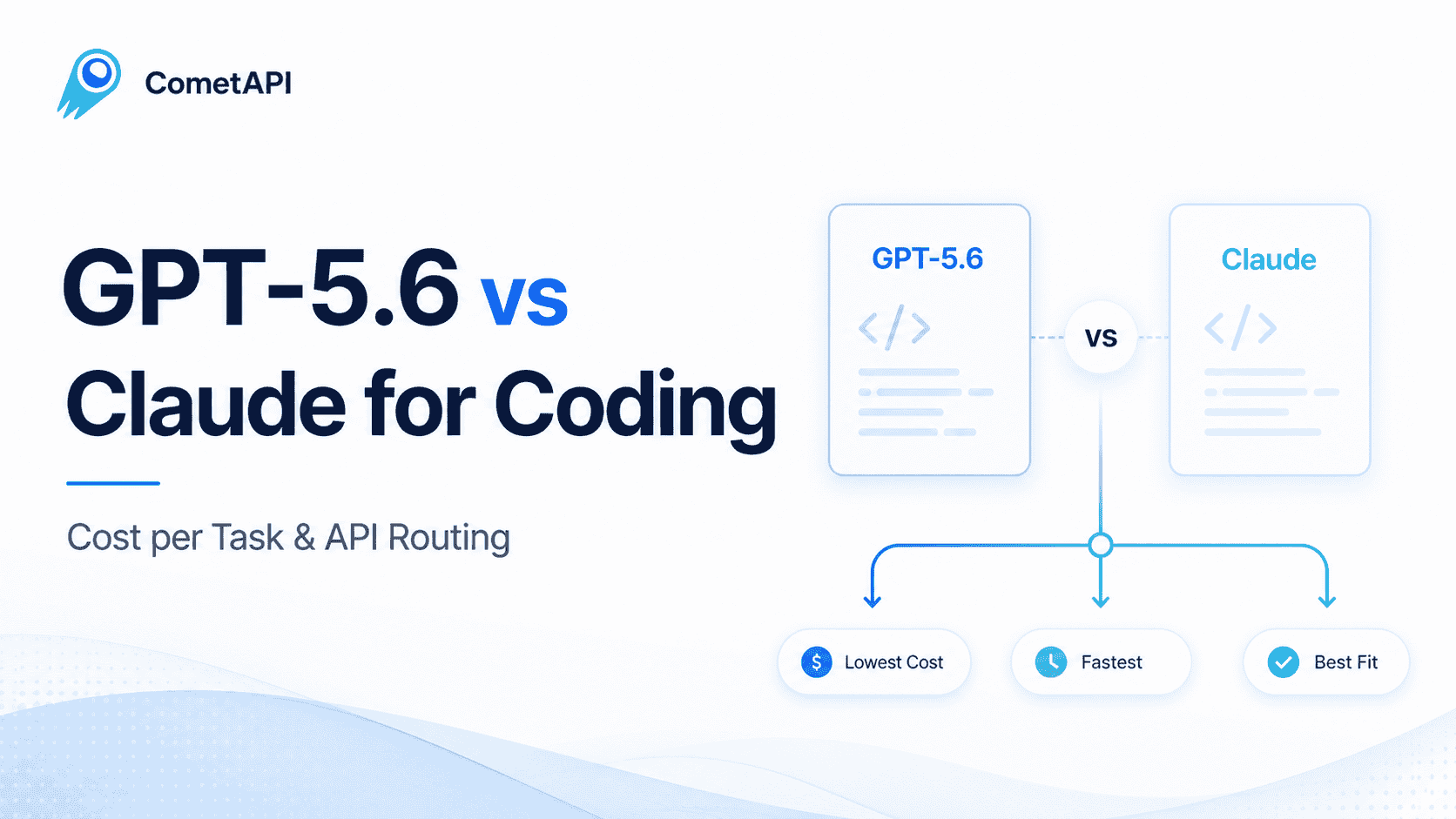
A practical framework for evaluating coding models beyond leaderboard scores and token pricing.
When developers compare GPT-5.6 and Claude for coding, the first thing they usually look at is benchmarks.
That makes sense.
Coding benchmarks give us a quick way to compare model capabilities across tasks such as software engineering, debugging, repository-level reasoning, and agentic coding.
But there is a problem.
A benchmark can tell you which models are worth testing.
It cannot always tell you which model should run your production coding workload.
After comparing GPT-5.6 and Claude across coding benchmarks, pricing, caching, and routing strategies, I think the more useful question is not:
Which model has the highest coding score?
It is:
Which model delivers the best result for my workload at the lowest total cost?
That difference matters more than it might seem.
Coding Benchmarks Can Point in Different Directions
Public benchmark results often produce different winners depending on the test.
In OpenAI's published GPT-5.6 evaluation results, GPT-5.6 Sol performs strongly on the Artificial Analysis Coding Agent Index, while Claude Fable 5 scores higher on SWE-Bench Pro.
So which one is better for coding?
The honest answer is: it depends.
Different benchmarks can evaluate different things.
They may use different:
Agent harnesses Tool configurations Execution environments Reasoning settings Task distributions Validation methods
A model that performs extremely well in one setup may not perform equally well on another type of coding task.
This doesn't make benchmarks useless.
It just means they should be interpreted correctly.
My preferred rule is:
Public benchmarks tell you which models to test. Your own eval tells you which model to deploy.
A Single Benchmark Score Hides Task Differences
"Coding" is not one workload.
A coding agent might be asked to:
Explain a function Generate unit tests Fix a scoped bug Review a pull request Refactor multiple files Debug a complex repository Make a security-sensitive change
These tasks have very different requirements.
A model that is efficient for code explanation may not be the model you want for a complex multi-file refactor.
Similarly, using the most capable model for every task may provide excellent quality but create unnecessary cost.
This is why evaluating one global coding benchmark and choosing one default model can be misleading.
A better approach is to evaluate models by task class.
For example:
Task Type Models to Test Lightweight explanation GPT-5.6 Luna / Claude Haiku General coding GPT-5.6 Terra / Claude Sonnet Difficult debugging GPT-5.6 Sol / Claude Opus Complex or high-value tasks Stronger routes + human review
These are not fixed rankings.
They are starting points for your own evaluation.
Token Pricing Has the Same Problem
The same mistake happens with pricing.
It is easy to compare models by cost per million tokens.
But production coding agents rarely complete every task in one call.
A real workflow might look like this:
User request ↓ Primary model ↓ Generate patch ↓ Run tests ↓ Tests fail ↓ Retry ↓ Fallback to stronger model ↓ Human review
If you only measure the cost of the first API call, you miss a large part of the system.
A cheaper model may become expensive if it:
Requires more retries Produces more failed patches Escalates frequently Generates longer outputs Requires more human correction
That leads to a better metric:
Cost per successful task
Instead of asking how much one model call costs, measure how much it costs to reach an accepted result.
A More Useful Cost Model
For a coding agent, I would think about total task cost like this:
Cost per successful task
Primary model cost
Retry cost
Fallback cost
Tool execution cost
Human review cost
This makes fallback rate especially important.
Imagine two routes:
GPT-5.6 Terra ↓ GPT-5.6 Sol on failure
and:
Claude Sonnet ↓ Claude Opus on failure
The primary model pricing matters.
But so does the probability of escalation.
A cheaper primary route that falls back 30% of the time may cost more than a slightly more expensive route that succeeds much more often on the first attempt.
The important metric is therefore not just:
$/1M tokens
It is closer to:
$/accepted coding task Caching Can Change the Economics
Coding agents frequently reuse context.
That context might include:
Repository structure Project instructions Tool definitions Coding standards Documentation System prompts
Prompt caching can reduce the cost of repeatedly sending that information.
But caching should not be evaluated in isolation.
Imagine a model with an excellent cache-hit rate.
That sounds efficient.
But if the model frequently fails and requires a stronger fallback, the overall route may still be expensive.
I would therefore track these three metrics together:
Cache-hit rate Retry rate Fallback rate
The interaction between them matters more than any one number.
A high cache-hit rate is valuable only if the route also produces acceptable results reliably.
Build a Small Eval on Your Own Codebase
You do not need a massive benchmark suite to start evaluating models.
A small set of representative tasks can already reveal useful differences.
For example:
30 tasks total
10 bug fixes 10 implementation or test-generation tasks 5 refactors 5 code reviews
Then test several candidate models against the same tasks.
A reasonable starting set might include:
GPT-5.6 Terra GPT-5.6 Sol Claude Sonnet Claude Opus
For lighter subtasks, you could also include Luna and Haiku.
The most important part is keeping the acceptance criteria consistent.
Use the Same Acceptance Criteria
For every model, ask the same questions.
Did the task pass automated checks?
For example:
pytest
or:
npm test
You might also run:
Type checking Linting Build validation AST validation Static analysis Did the patch actually solve the problem?
Passing tests is important, but the output still needs to satisfy the requested task.
How much human correction was required?
A model that generates an almost-correct answer every time may still create significant engineering overhead.
That review time should be part of the evaluation.
What I Would Track
For each coding task, I would log at least the following.
Metric Why It Matters First-pass success Shows how often the primary route works immediately Final success Measures success after retries or escalation Retry count Reveals hidden API cost Fallback rate Determines premium-model usage Input/output tokens Measures base model cost Cached tokens Shows context reuse Total API cost Captures the full task workflow Latency Measures user impact Review time Captures engineering overhead
Then segment the results by task type.
You may find that:
Model A performs best for code review Model B is more cost-effective for bug fixes Model C is only worth using for difficult refactors
That is much more actionable than choosing one winner from a leaderboard.
Turn Evaluation Into Routing
Once you have your own evaluation data, model selection becomes a routing problem.
A simple production strategy could be:
Classify task ↓ Choose lowest-cost route that passed your eval ↓ Generate result ↓ Validate automatically ↓ Pass? ───── Yes ─────→ Done │ No ↓ Escalate to stronger model ↓ Validate again ↓ Human review if required
The important part is that the route is determined by data.
Not by brand preference.
Not by the latest leaderboard.
And not by token price alone.
A Practical Escalation Strategy
An initial routing system might look something like:
Luna / Haiku ↓ Terra / Sonnet ↓ Sol / Opus ↓ Higher-capability model or human review
You should eventually replace these generic rules with your own telemetry.
For example:
If fallback rate is too high
Use a stronger primary model.
If premium models rarely improve final success
Reduce escalation.
If repeated context dominates API spend
Improve caching.
If higher reasoning effort increases cost without improving results
Reduce the effort level.
The goal is not to use the cheapest model possible.
It is to find:
The lowest-cost path to a correct result.
Model Flexibility Becomes Part of the Architecture
There is another consequence of this approach.
The best route today may not be the best route three months from now.
Models change.
Pricing changes.
New model tiers appear.
Your workload changes.
That means production AI systems benefit from being able to switch routes without rebuilding the entire application.
One approach is to use a unified API layer.
For example, CometAPI provides an OpenAI-compatible interface for accessing models across multiple providers.
That allows developers to test and switch supported models using a similar request structure rather than maintaining a completely separate integration for every provider.
The routing logic still belongs to your application.
The evaluation data still needs to come from your workload.
But reducing integration friction makes it easier to act when your data says the preferred model should change.
The Real GPT-5.6 vs Claude Question
So, is GPT-5.6 better than Claude for coding?
I don't think there is a useful universal answer.
A better question is:
Which GPT-5.6 or Claude route works best for this specific type of coding task?
And to answer that, I would combine:
Public benchmarks + Your own evaluation + Cost per successful task + Fallback rate + Caching behavior + Latency + Human review effort
Benchmarks are useful.
Pricing is useful.
But neither should be treated as the final deployment decision.
For production coding agents, the best model may not actually be one model.
It may be a route.
Final Takeaway
My main takeaway from comparing GPT-5.6 and Claude is simple:
Don't optimize only for the highest benchmark score.
And don't optimize only for the lowest token price.
Instead, measure how each model performs across your own coding tasks.
Track the full workflow.
Measure retries.
Measure fallback.
Measure caching.
Measure human review.
Then route each task to the lowest-cost model that can reliably complete it.
That's a much more useful definition of "best coding model."
I explored the full comparison—including GPT-5.6 and Claude coding benchmarks, API pricing, prompt caching, worked cost-per-task examples, and production routing strategies—in this deeper analysis:
Read the full GPT-5.6 vs Claude for Coding comparison on CometAPI →


